For strata managers
The car is the meter.
Every charger vendor sells you a meter bolted to the wall. Your residents already drive one — it is more accurate, it costs nothing, and it is already installed.
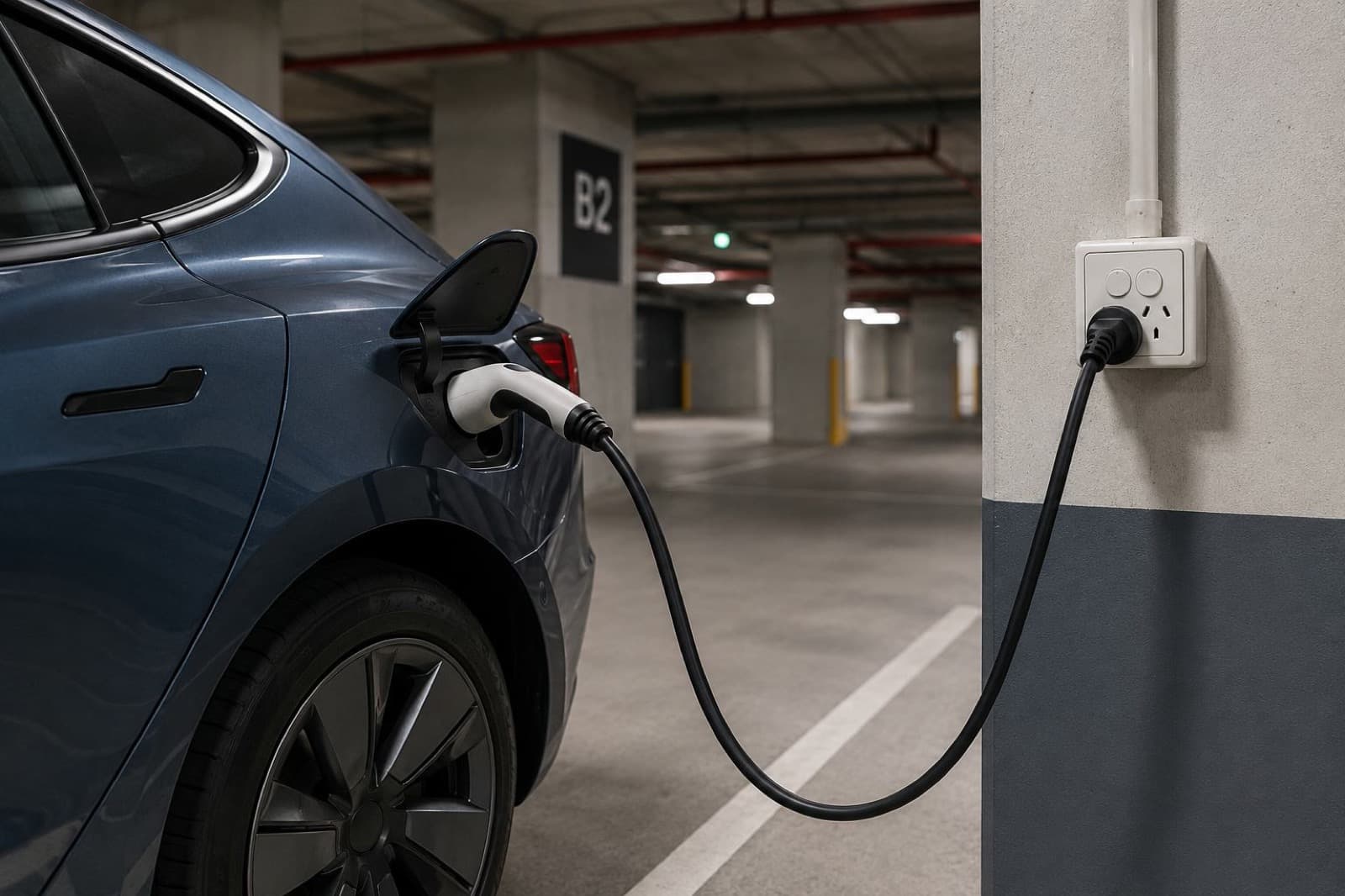
How metering without a meter works
Modern electric cars report their own state constantly: whether they are plugged in, whether they are charging, how full the battery is and where they are parked. That information already flows to the manufacturer app the driver uses.
With the driver’s permission, Volty reads that same data through Enode, the vehicle API that connects to those manufacturer accounts. When a car starts charging inside your building’s boundary, a session opens. When it stops, Volty works out how much energy went in from the change in battery level and the car’s usable capacity, and bills it at your rate.
That is the entire mechanism. No sub-meter, no smart socket, no CT clamp, no wiring changes, and nothing that can fail and need replacing.
What this saves you
Fair questions about the approach
- Is reading the car as accurate as a meter?
- For billing a resident it is accurate enough and it is transparent: energy delivered is derived from the battery’s own reported state, and the driver can see exactly the same figure in their app. It measures what went into the car rather than what came out of the wall, which is the number a driver expects to pay for.
- What if the carpark has no mobile signal?
- Cars report through their own connection, and basements are often poor for that. Volty tolerates it: the session is reconstructed from the reports either side of the gap once the car reconnects. The worst case is a session that is not billed at all, never one that is billed wrongly.
- What if a resident’s car is not supported?
- Then Volty cannot bill them and they should not be charging. Coverage spans most major brands sold in Australia through Enode, and the supported list is worth checking before you roll out to a building.
- Does this stop people plugging in without paying?
- Volty is a billing system, not a lock. Buildings that want enforcement usually pair it with a simple by-law: charging is permitted only with a linked account. The difference is that residents now have a legitimate way to pay, which is what actually stops the unauthorised plugging in.
Bring Volty to your building
Tell us about your building and we'll be in touch as we roll out — or book a time and we'll walk you through it.